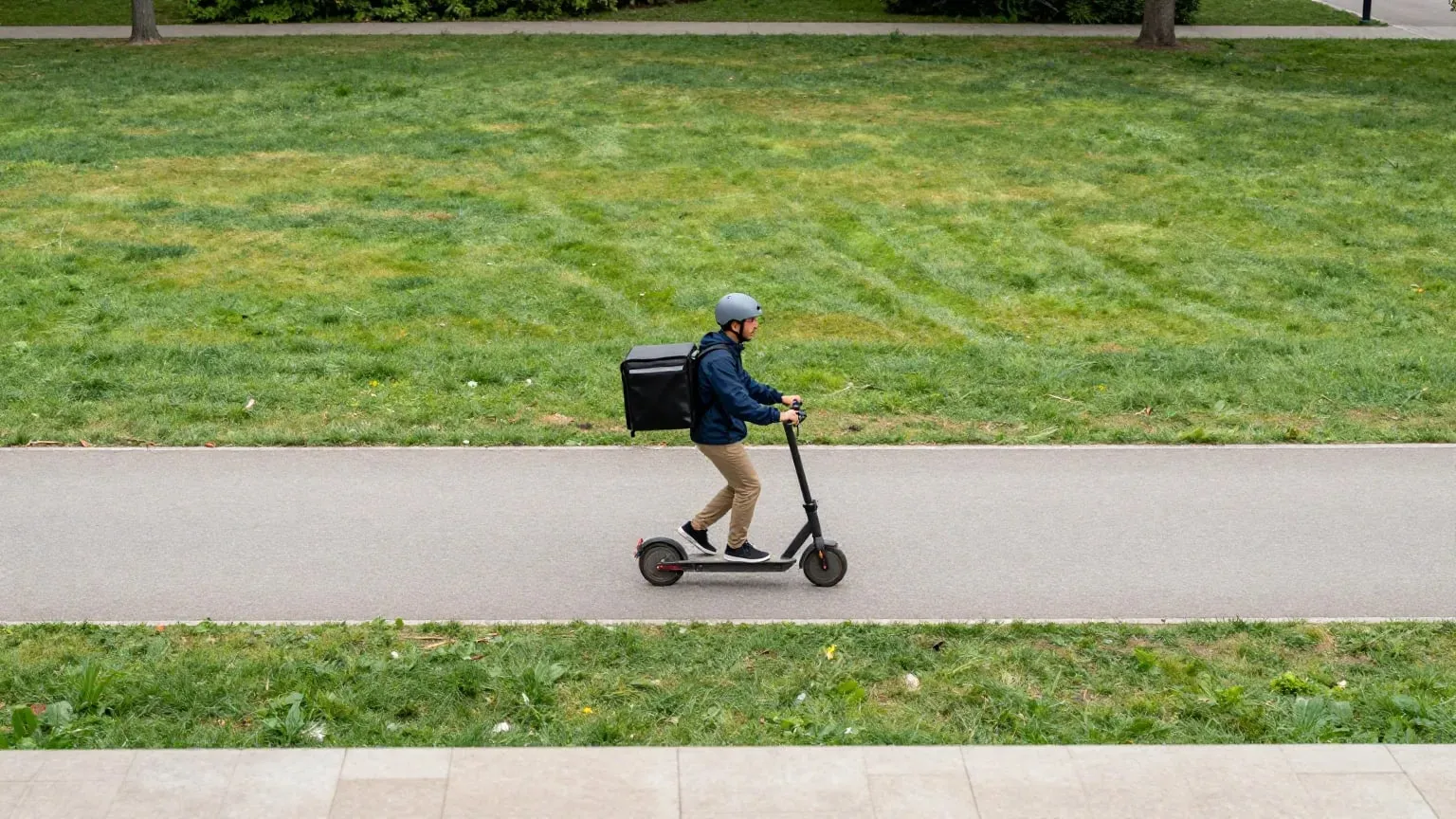

Rideshare and Delivery Drivers: Where Personal Auto Policies Stop
Most personal auto policies exclude driving for pay. See exactly where the gaps fall for rideshare and delivery drivers and how to close them.
A rideshare endorsement is an add-on to your personal auto policy that keeps some of your coverage working while you’re logged into Uber or Lyft. Its biggest job is usually the waiting period, when the app is on but no ride is accepted, because that’s where personal policies often exclude you and platform coverage is thinnest. Endorsements are not standardized, so the only way to know what yours does is to match its wording against each app period.
Most guidance, including the NAIC’s (opens in a new tab), describes three app-on periods. Add “app off” and you get four moments to check.
App off. You’re a regular driver. Your personal policy applies as written, and neither Uber nor Lyft maintains coverage for you. Lyft’s help center (opens in a new tab) says it has no policy for this period.
Period 1: app on, waiting. You’re available for requests. This is the period the endorsement exists for. Many personal policies exclude it, and the platform’s coverage is limited: Uber (opens in a new tab) lists at least $50,000 per person and $100,000 per accident in bodily injury liability and $25,000 in property damage, and no collision or comprehensive for your car. Lyft describes the same figures in most states, applying if your personal insurance doesn’t, with lower limits in Arizona and Nebraska.
Period 2: ride accepted, en route to pickup. Platform coverage steps up. Uber and Lyft both describe at least $1 million in third-party liability in most markets, and Lyft notes lower en-route limits in Maryland and Arizona.
Period 3: passenger in the car. Similar platform coverage to period 2. Both platforms describe contingent collision and comprehensive up to your car’s actual cash value with a $2,500 deductible, available only if you carry those coverages on your personal policy.
State law sets the floor for all of this. The NAIC explains that most state transportation network company laws grew out of a model bill using $50,000/$100,000/$25,000 in period 1 and $1 million in primary commercial liability once a ride is accepted, but several states combine periods or set different numbers. Platform terms also change; Uber’s own page notes its coverages vary by state and have changed over time.
| Period | Without an endorsement | With a typical endorsement (confirm yours) | Question to ask your insurer |
|---|---|---|---|
| App off | Personal policy applies | No change | None |
| 1: Waiting | Platform liability at lower limits, often contingent; your car and your injuries may be uncovered | Personal coverages may extend into this period | “Does the endorsement restore collision, comprehensive, PIP and UM/UIM while I’m waiting?” |
| 2: En route | Platform liability at higher limits; contingent physical damage | Some endorsements stop at period 1; others extend further | “Does the endorsement apply after I accept a ride, and in what order with the platform’s coverage?” |
| 3: On trip | Same as period 2 | Same as period 2 | “Does anything help with the platform’s $2,500 deductible?” |
The NAIC flags the most important variation directly: some policies only cover the time you’re logged in but haven’t accepted a request. That’s not necessarily bad, since period 1 is the biggest hole, but it means you’re relying on the platform for periods 2 and 3.
Imagine a driver who’s logged into the app and waiting outside a stadium when another car backs into her bumper, and she’s partly at fault for stopping in a lane.
Now imagine the same accident during a trip. With or without an endorsement, the platform’s $1 million liability layer is in play. Her car repair runs through the platform’s contingent physical damage coverage, but only if her personal policy carries collision, and she pays a $2,500 deductible. If her endorsement doesn’t extend to trips, that deductible is hers.
These examples are simplified. Real claims depend on policy wording, state law and fault, and drivers should always disclose app status when reporting. The NAIC (opens in a new tab) notes several states require it.
| Option | Built for | Watch out for |
|---|---|---|
| Rideshare endorsement | Part-time and full-time rideshare drivers using a personal car | May cover only period 1; may not include delivery |
| Delivery endorsement or business-use rating | Food, grocery and package delivery | Separate from rideshare at many insurers; may exclude goods or cargo |
| Hybrid personal/TNC policy | Drivers who want one policy for all driving | The Triple-I (opens in a new tab) notes only a handful of insurers offer these, in some states |
| Commercial auto | Cars used primarily for business or owned by a business | Higher cost; may be required for livery, private clients or business-owned vehicles |
The Utah Insurance Department (opens in a new tab) reminds drivers that an un-endorsed personal policy doesn’t cover carrying passengers for hire, and that business uses beyond commuting and pleasure driving may need either an endorsement or a commercial policy. If you’re unsure which side of that line you’re on, read when business use of your car needs commercial auto.
Buying the endorsement and dropping collision to offset the cost. That can switch off the platforms’ contingent physical damage coverage entirely. For high-mileage drivers deciding whether collision is still worth it, see comprehensive vs. collision math.
Assuming rideshare coverage covers deliveries. Uber’s own page says its rideshare coverages aren’t typically available for delivery and describes separate delivery coverage. The Texas Department of Insurance (opens in a new tab) recommends asking specifically about delivery coverage.
Not updating the policy when your driving changes. Going from weekend rides to 50 hours a week is a material change. Tell your insurer.
Forgetting the basics. The endorsement rides on your personal policy. If the base limits are low or the policy lapses, the endorsement doesn’t help. Our post on where personal auto policies stop for rideshare and delivery drivers covers the underlying gaps in detail.
The right endorsement depends on your state, your platforms and how many hours you drive. Book a free consultation with a licensed agent and we’ll compare endorsement wording side by side, check how it lines up with each app period, and tell you plainly if your driving has outgrown it. Learn more about our rideshare, delivery and business-use auto options, or if a past violation is making coverage hard to find, see high-risk auto and SR-22 filings.
It modifies your personal auto policy so that some or all of its coverage keeps applying while you're logged into a rideshare app. Endorsements differ a lot between insurers: some only cover the time you're waiting for a request, while others extend more of your policy. Ask for the endorsement wording and read which periods it names.
State rules on who must carry what during each period vary. In many states the platform or the driver can satisfy the requirements. Even where an endorsement isn't legally required, it can be the only thing covering your own car or your own injuries in the waiting period.
Not necessarily. Rideshare and delivery are often treated separately by insurers, and the platforms themselves describe different coverage for each. If you drive for both, ask whether the endorsement names delivery activity specifically.
Generally yes, but the order matters. Lyft, for example, describes its waiting-period liability as applying if your personal insurance does not. Once your endorsement responds, it may become the first layer, with the platform's coverage behind it. Your insurer can explain how its form coordinates.
When the car is mostly a work vehicle, when it's owned by your business, when other people drive it for work, or when you drive outside the rideshare and delivery apps the endorsement names. Those situations often call for a commercial auto policy.

Most personal auto policies exclude driving for pay. See exactly where the gaps fall for rideshare and delivery drivers and how to close them.
Do you still need collision and comprehensive on a high-mileage work car? A worksheet for rideshare, delivery and road-heavy freelancers.
Owe more on your rideshare or delivery car than it's worth? How gap coverage works, why high mileage widens the gap, and the business-use catch to check.
Book a time with a licensed agent. We’ll line up health and auto options that fit how you actually earn, at no cost to you.